
The Best ME/CFS and Long COVID Treatment Guides in the U.S.: A Round-Up for Patients, Caregivers, and Clinicians
Updated: Jul 16

After years of limited clinical guidance for ME/CFS, Long COVID, and related infection-associated chronic conditions, we now have some substantive treatment guides to reference. Four guides published in 2025 and 2026 by well-respected U.S. clinicians and organizations focus on different aspects of diagnosis, symptom management, and treatment.
While there is still no established cure for these debilitating illnesses, these resources discuss off-label medications, supplements, lifestyle modifications, rehabilitation strategies, and emerging clinical approaches that may help improve quality of life.
Because each guide has a different focus and unique strengths, many readers may benefit from reviewing all four. This blog post provides a high-level overview to help you decide where to start, given your situation and interests.
Please note: All of these guides are intended to be educational in nature and are not intended as medical advice. Always consult with a licensed clinician before making any changes to your treatment regimen.
Starting in order of the most recent publications:

Best for: Patients seeking a concise list of off-label treatment options to discuss with clinicians.
Synopsis:
Patient advocates and clinicians at the Patient-Led Research Collaborative and RTHM created their Long COVID Treatment guide to facilitate productive, evidence-based conversations between patients and doctors about treatment options, with a strong focus on “off-label” medications. (“Off-label” medications mean a doctor prescribes an approved drug for a different health condition than what health authorities officially approve.)
The guide identifies 24 prescription medications, along with select supplements and over-the-counter medications, some lifestyle strategies, and a few procedures to consider. (Note that people with ME/CFS and other illnesses similar to Long COVID may also benefit.) Rather than creating a comprehensive handbook, the authors focused on a concise "hit list" of treatments that patients can bring to appointments.
“The design was intended to be for starting a conversation with a clinician in a limited amount of time, where they don't really have time to read through a lot of info. It's in a one-page-per-treatment format to facilitate that for the sake of time,” says Jennifer Curtin, co-founder and chief medical officer for RHTM, an online clinic specializing in these illnesses.
The PLRC-RTHM team drew from the Harvard/Stanford TREATME study, a patient-led survey of nearly 4,000 people with ME/CFS and Long COVID that asked questions like “What have you tried and how did it help you feel better?” The team then picked treatments that showed at least a moderate to significant improvement for a good number of people, says Curtin. They then looked to see if these treatments had high-quality clinical studies where a good number of people reported a "pretty positive" benefit.
What Makes This Guide Unique?
Focused on prescription medications that can be used off-label, and includes a handful of supplements, over-the-counter medications, lifestyle strategies, and procedures. (Note that different countries vary in patients' ability to get “off-label” medications.)
Short and concise, formatted to be “at a glance.”
Created so patients can take a printout to a primary care doctor who has limited time to look into new treatments.
Additional Resources:
Video recording of the June 12, 2026 RTHM-PLRC webinar discussing their Long COVID Treatment Guide
Here’s the Table of Contents:

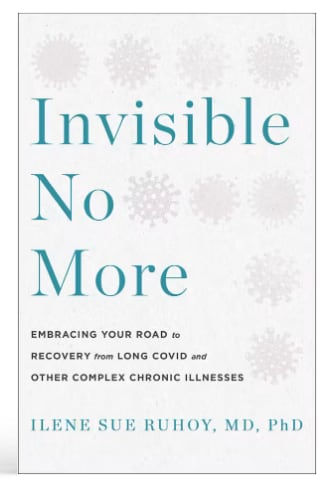
2) Dr. Ilene Ruhoy’s 2025 book “Invisible No More, Embracing Your Road to Recovery from Long COVID and Other Complex Chronic Illnesses”
Best for: Readers interested in integrative medicine approaches alongside conventional treatments.
Synopsis:
Dr. Ilene Ruhoy, MD, PhD, is an “integrative neurologist” and environmental toxicologist who combines pharmacological and alternative health approaches in her practice. She has special expertise in chronic, complex illnesses, especially Ehlers-Danlos and the role of connective tissue in neurological disease. She is also the co-creator with Dr. David Kaufman of their “Unraveled: Understanding Complex Illness” YouTube podcast series. (I was invited to speak about caregiving on their podcast last year. Here’s the episode.)
Dr. Ruhoy starts off the book sharing her own personal life experiences, which have shaped her medical practice and approach. After 10 years as a neurologist, she started suffering unusual health issues and was dismissed by her own doctors. Only after she insisted on getting an MRI months later was she diagnosed with a large brain tumor that required immediate removal. So she understands what many complex, chronic illness patients go through.
Rather than centering exclusively on medications, Dr. Ruhoy emphasizes foundational factors such as sleep, nutrition, breathing, movement, neuroinflammation, mitochondrial health, and nervous system regulation, and also discusses regenerative therapies such as peptides, stem cell therapy, plasmapheresis, and red-light therapy.
She also provides neuroinflammatory and mitochondrial repair protocols (a list of pharmaceutical drugs and supplements to address these two foundational areas for chronic illness patients).
What Makes This Guide Unique?
While acknowledging pharmaceutical approaches, the book emphasizes integrative medicine approaches, including diet & nutrition, improving sleep quality, breathing exercises, and movement done slowly and carefully.
It provides neuroinflammatory and mitochondrial repair protocols (lists of drugs and supplements to address these two foundational areas for infection-associated chronic illnesses).
The appendix includes “How to Treat Common Post-Exposure Illness Symptoms Non-Pharmacologically.” Since many people with ME/CFS and Long COVID are sensitive to medications, this list can be helpful to them.
Additional Resources:
“Invisible No More”: Exploring Dr. Ruhoy’s New Treatment Guide for ME/CFS, Long COVID, etc. - a more detailed book synopsis and commentary from Cort Johnson’s Health Rising blog
”Unraveled: Understanding Complex Illness” YouTube podcast series hosted by Dr. Ilene Ruhoy and Dr. David Kaufman
Dr. Ilene Ruhoy’s professional bio at Atria, where she is currently Director of Neuroimmune and Connective Tissue Neurology
Here’s the Table of Contents:


Best for: Patients, caregivers, and clinicians seeking a comprehensive clinical reference. It also has chapters dedicated to pediatric & young adults, as well as severe and very severe considerations.
Synopsis:
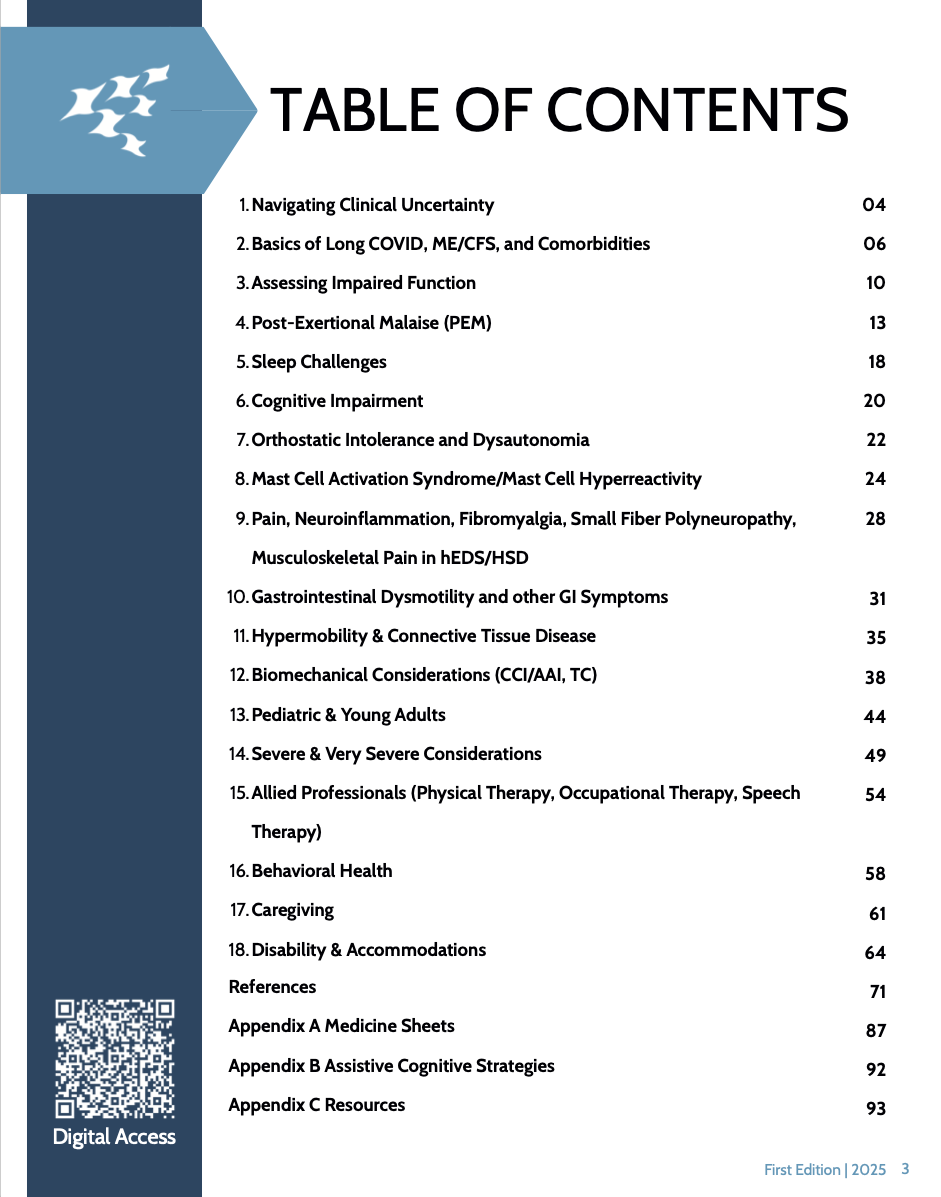
Bateman Horne’s Clinicial Care Guide is a comprehensive 97-page guide that provides a step-by-step framework for assessment, diagnosis, symptom management, and ongoing care for complex chronic illnesses.
Published in 2025, it was written by an interdisciplinary team of clinicians, educators, researchers, and lived experience experts, including Bateman Horne Center staff. Bateman Horne Center is a U.S.-based nonprofit organization and Center of Excellence dedicated to advancing clinical care, research, and education for ME/CFS, Long COVID, and related post-infectious conditions.
The guide aims to provide practical, immediately applicable clinical guidance for managing the functional, autonomic, and multisystem impairments characteristic of ME/CFS and overlapping post-infectious syndromes. Many patients and caregivers print out the guide or send an electronic copy to their medical providers to help them better understand these illnesses.
Chapters cover navigating clinical uncertainty, the basics of Long COVID, ME/CFS, and comorbidities, assessing impaired function, and then several chapters on common symptoms of these illnesses, as well as hypermobility and connective tissue diseases, craniocervical instability, and other anatomical complications.
Bateman Horne’s Clinical Care Guide also includes chapters on pediatric & young adults; severe & very severe considerations; physical therapy, occupational therapy, & speech therapy; behavioral health; caregiving; and disability & accommodations.
What’s especially noteworthy is that the Bateman Horne Center hosts a monthly “Coffee with a Clinician” webinar series, where a panel of medical specialists discusses topics in the clinical care guide. The webinars are free to attend with an optional $5 donation to support BHC’s education and outreach programs. You can sign up for the webinars on Bateman Horne’s “support and connect” webpage. And you can watch previous sessions on Bateman Horne’s YouTube channel.
What Makes This Guide Unique?
The guide is simultaneously comprehensive, concise, and easy to scan, partly because it is written in an outline format with bullet points.
Chapters dedicated to pediatric & young adults; severe & very severe considerations; behavioral health; caregiving; and disability & accommodations.
The Bateman Horne Center hosts a monthly “Coffee with a Clinician” webinar series, where a panel of medical experts discusses topics in the clinical care guide.
Additional Resources:
Bateman Horne Center has been hosting a monthly “Coffee with a Clinician” webinar series, where medical experts discuss topics raised in their comprehensive guide.
You can sign up for “Coffee with a Clinician” webinars. Webinars are free with an optional $5 donation to support educational programs.
You can watch “Coffee with a Clinician” video replays on their YouTube channel.
Bateman Horne has created a list of top resources to assess, diagnose, and manage ME/CFS and related illnesses.
Bateman Horne produces educational materials for health professionals, hosts invitation-only healthcare provider weekly meetings, and monthly medical education lectures that include continuing medical education credits, in addition to hosting twice-a-month support group meetings for people with ME/CFS, Long COVID and related illnesses.
Here’s the Table of Contents:

Best for: Readers who want a deeper understanding of disease biological mechanisms and clinical care protocols. There's also a chapter focused on tick-borne and vector-borne illnesses. Synopsis: Mt. Sinai’s Infection-Associated Chronic Illness Provider Manual is a comprehensive 126-page guide that was first published in 2025 by the Cohen Center for Recovery from Complex Chronic Illness at the Icahn School of Medicine at Mount Sinai in New York City.
An updated 2nd edition was published in May 2026. It features expanded sections on tick- and vector-borne illnesses, clarified language on the role of autonomic rehabilitation in patient care, and updated information about recent and upcoming research at the Cohen Center for Recovery from Complex Chronic Illness at Mount Sinai.
One of the guide's most distinctive features is its discussion of current research into the "drivers of disease"—the biological mechanisms believed to contribute to persistent symptoms of infection-associated illnesses. Helpful diagrams illustrate these complex processes. See the screenshot below of the “drivers of disease” list that the center's director Dr. David Putrino recommends healthcare providers focus on.

The manual also outlines the clinical care guidelines the Cohen Center at Mount Sinai uses, including using HEPA filters and germicidal far-UV light technology to help minimize patients’ risk of contracting COVID-19 and other viruses during in-person clinical and research visits.
It also provides physical therapy guidelines for conditions such as Ehlers-Danlos syndrome, dysautonomia, and craniocervical instability. The manual emphasizes the potential harm that incorrectly prescribed cardiovascular exercise can cause for patients who experience post-exertional malaise.
What Makes This Guide Unique?
The guide includes explanations of molecular-level understanding of the biophysical processes in patients’ bodies that may cause debilitating symptoms, providing a greater understanding of why certain symptoms may take place.
The updated version of the guide has a chapter focused on tick-borne and vector-borne illnesses such as chronic Lyme disease, babesia infection, and Bartonella infection.
The appendix includes detailed autonomic rehabilitation protocols to consider, as well as a meaty section on hypermobility spectrum disorders and hypermobility testing.
Additional Resources:
Cohen Center for Recovery from Complex Chronic Illness YouTube channel, which includes monthly “Ask Me Anything” videos with center director Dr. David Putrino.
“California clinicians gather for Long COVID forum. Recent guides offer direction.” by The Sick Times includes coverage of Dr. Putrino's keynote presentation.
“New Long COVID and complex disease center at Mount Sinai set to be a leader in research, clinical care” by The Sick Times, published in 2024.
Here’s the Table of Contents:


Bonus: Caregiver Wisdom blog post “Navigating Clinical Uncertainty: Practical Tips for ME/CFS and Long COVID Caregivers” In addition to these four substantive treatment guides, I’d also like to share the Caregiver Wisdom blog post “Navigating Clinical Uncertainty: Practical Tips for ME/CFS and Long COVID Caregivers.” The blog post grew out of Bateman Horne Center’s first “Coffee with a Clinician” webinar in the fall of 2025. I took extensive notes throughout the session and was struck by the thoughtful advice shared by both clinicians and community members in the Zoom chat. Drawing on those insights, along with my own caregiving experience, I pulled together practical strategies for preparing for medical appointments and approaching treatment decisions collaboratively with clinicians. Ultimately, one of the most important lessons from these guides and educational resources is that patients, caregivers, and clinicians are all learning together. While many questions remain unanswered, informed, collaborative, and compassionate care can help people navigate uncertainty more effectively.
These four treatment guides reflect how much the field has evolved in recent years. While no single guide covers everything, each contributes a valuable perspective—from concise treatment discussions to integrative medicine approaches, comprehensive clinical management, and biophysical mechanisms believed to lead to debilitating symptoms.
Whether you're a patient, caregiver, or medical professional, these guides and educational resources can help inform more productive conversations and support more individualized care. If you're a caregiver seeking support, you may want to join our free monthly support group meetings. Join our email newsletter to get updates and other caregiver support resources.


